
This week is Salt Awareness Week, and Action on Salt & Sugar (a non-profit organisation working to improve population health and food environments through nutritional research) has published a report on the nutritional analysis of ready to eat sandwiches in the UK.
The report analysed 546 ready-to-eat sandwiches available across UK retail and out of-home (OOH) sectors, assessing levels of key nutrients of concern (salt, sugar, saturated fat) and evaluating their compliance with government reformulation targets and labelling criteria.
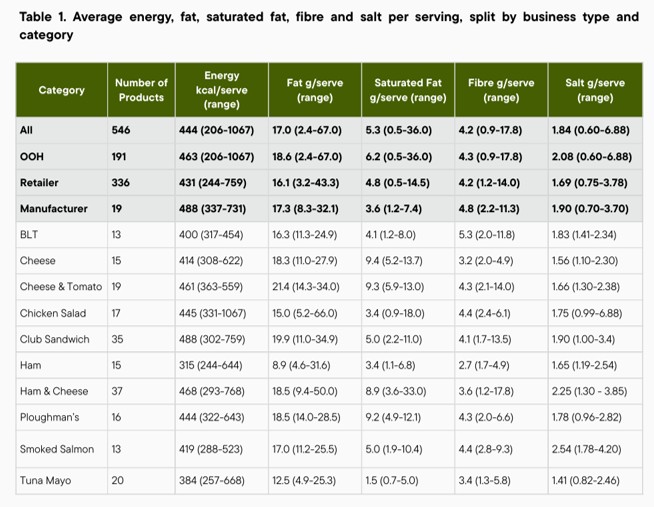
The overall nutrition content of the sandwiches summarised below showed that the average sandwich contains 444kcal and provides 26% of daily maximum saturated fat intake, 31% maximum salt limit and only 14% of an adult’s daily fibre recommendation. The really interesting point is the range of nutrient content within the same sandwich category, for example a ham and cheese sandwich ranged in calorie content from 293 – 768Kcal, showing that healthy reformulation is possible and that the choice you make can have a significantly detrimental impact on your daily nutritional intake.
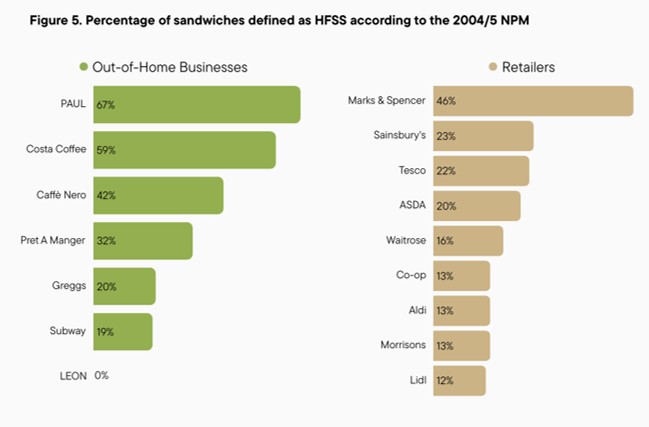
When comparing the nutrient profile model of sandwiches from all outlets 1 in 4 sandwiches would be classified as high in fat, salt and sugar, and of these a higher proportion of these were sold in out-of-home businesses (cafes, restaurants etc) compared to retail settings (supermarkets etc).
One of the key messages of this report is how important it is to read the label of any food that you consume out of the home, it is alarming how very similar products can have substantially different nutrient profiles that can result in an unnecessarily high intake of calories, salt, sugar and saturated fat. This is especially important for lunchtime as for most people this is proportionally a lighter meal compared to the evening meal, if a packet of sandwiches contributes around 500 calories for the average person this is 25%/20% of your recommended daily energy intake for women/men. This is a high percentage especially when taking into consideration that most people consume sandwiches alongside other food items, bringing the energy contribution even higher.
You could mitigate for this by trying to bring lunch from home when possible and if you cannot then it is better to buy from a retailer and that you carefully consult the label, checking the calorie content, saturated fat, sugar and salt are low and fibre is high and the protein is a sustainable source.
References
Action on Salt & Sugar. Salt out our sandwiches! A nutritional analysis of the lunch-on-the-go staple. 2026. Available at: https://www.actiononsalt.org.uk/media/action-on-salt/awareness/saltaw-2026/Action-on-Salt-&-Sugar—Sandwiches-Report_May-2026.pdf.

