
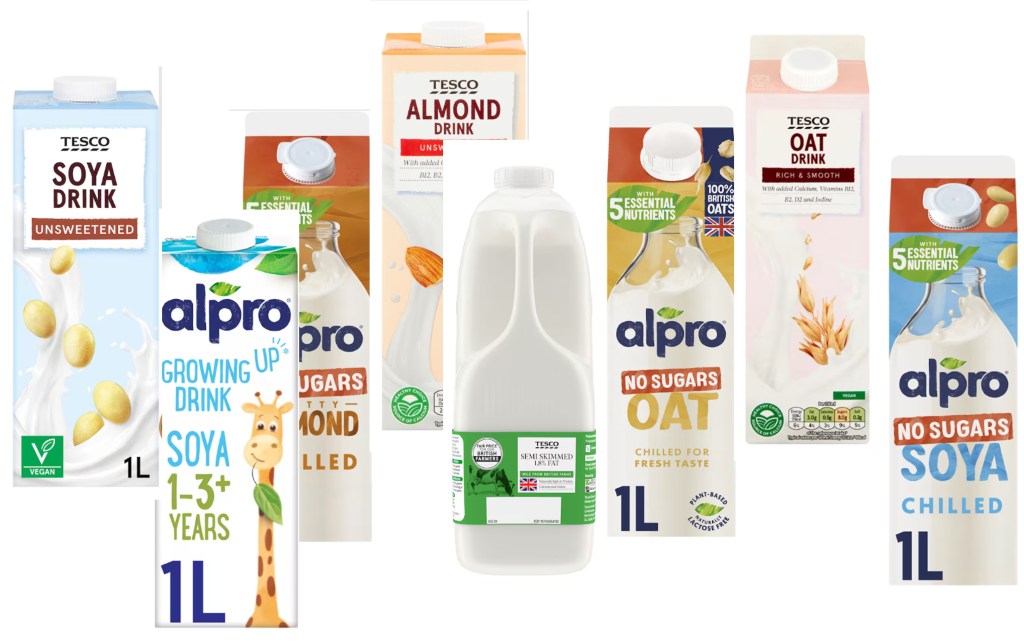
Plant based milks have steadily increased in popularity in recent years, in part due to environmental and animal welfare concerns but also due to the health benefits they are perceived to convey.
These health benefits are unfortunately often misplaced as highlighted in a recent independent report carried out by the UK government (UK Gov, 2025), which stated that no current almond, soya or oat milk on sale in the UK is nutritionally comparable to cow’s milk and they recommend children of 1-5 years old only consume semi-skimmed or whole cow’s milk.
In order for plant-based milks to fulfil nutritional requirements they need to be fortified with adequate levels of the following micronutrients:
- vitamin A
- riboflavin
- vitamin B12
- calcium
- iodine
- vitamin D
It is important to remember that organic products cannot contain synthetic additives in the UK which means organic plant-based milks aren’t fortified. It is also best to avoid sweetened versions as these contain higher levels of free sugars compared to unsweetened, making this a healthier option.

Shown below are comparisons of the nutritional profile of unsweetened soya, oat and almond milk options of the same brand compared to cow’s milk.
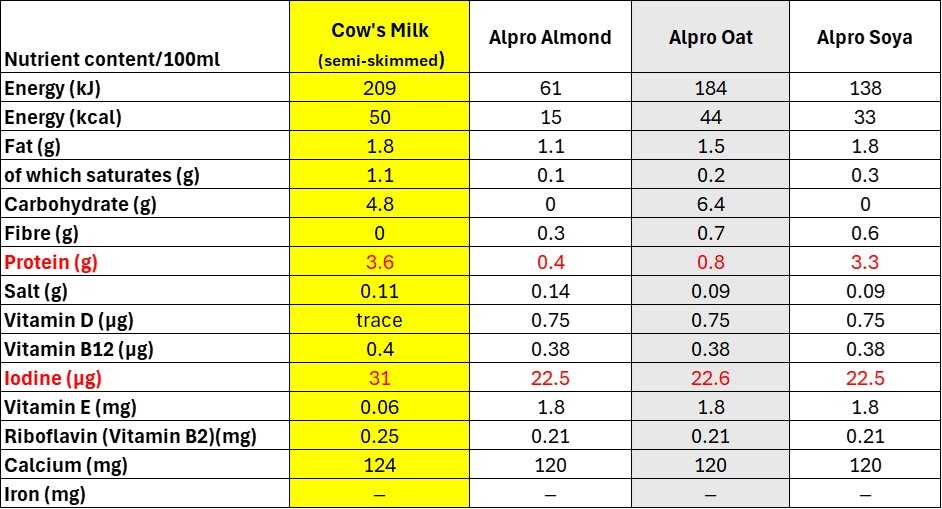
As you can see the fortified versions of these plant based milks don’t vary too much from that of cow’s milk, in general iodine is higher in cow’s milk, and this is important because in the last national diet and nutrition survey in the UK, an overall decline in iodine status was observed across the population in particular for women and girls. It was suggested that this could be due to the increased consumption of plant-based milks.
Protein levels are also overall higher in cow’s milk except for soya which has a similar profile, this is particularly important for children, older adults and menopausal women who all require adequate levels to maintain, grow and repair tissues.
Overall, soya milk is most nutritionally comparable to cow’s milk and the best option, although for children it was highlighted within the UK Government report that if children are consuming this regularly alongside other soy-based products, they could be ingesting high levels of isoflavones due to their small body size, which is not advisable. The report also pointed out that the fortification of nutrients does not necessarily guarantee their bioavailability – their ability to be easily digested and absorbed as naturally occurring micronutrients in cow’s milk are.
In summary, if you are choosing to consume plant-based milks, remember to consider the following three points:
- Choose an unsweetened version.
- Ensure it is fortified, avoid organic.
- Soya is generally the best option as it has the most similar nutrient profile to cow’s milk.
The decision to replace cow’s milk with a plant-based milk should be made carefully as choosing the wrong product has the potential to lead to inadequate intake of some micronutrients, this is especially important to groups such as children, older adults and menopausal women.
References
UK Government. (2025) SACN and COT assessment of the health benefits and risks of consuming plant-based drinks: summary. https://www.gov.uk/government/publications/plant-based-drinks-health-benefits-and-risks/sacn-and-cot-assessment-of-the-health-benefits-and-risks-of-consuming-plant-based-drinks-summary
 MLT Nutrition