
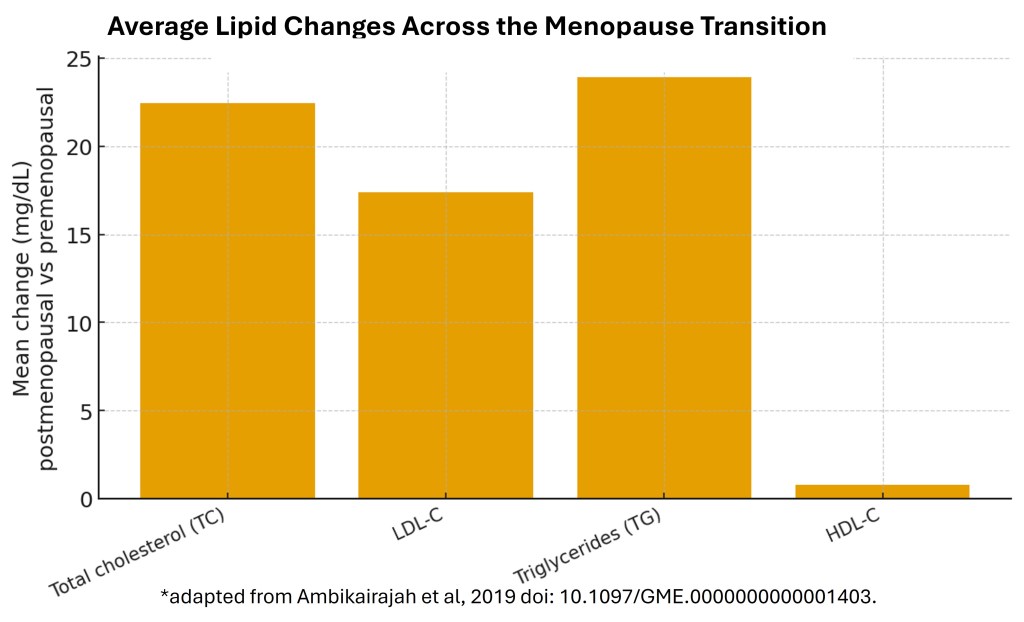
As some women go through the menopause transition their blood lipid profile can become negatively impacted (Derby et al., 2009). On average, these changes start in late perimenopause (~3-5 years before final menstrual period) and continue after menopause, many studies have shown that this change cannot be explained by aging alone (Ambikairajah et al., 2019).
The predominant changes observed include:
- An increase in LDL-cholesterol (‘bad’ cholesterol) and total cholesterol
- An increase in triglycerides
- A decrease in HDL-cholesterol (‘good’ cholesterol)
A fall in HDL-cholesterol is not seen consistently, but it’s composition and function worsen after menopause reducing it’s protective effect (El Khoudary et al., 2021).
The biological mechanisms are thought to be predominantly due to the reducing levels of oestrogen (Ko & Kim, 2020). Oestrogen helps clear LDL-C by upregulating hepatic LDL receptors as well as suppressing hepatic lipase that changes the composition of HDL-C. Oestrogen also influences the metabolism of triglycerides and their distribution across the body, most typically causing an accumulation of visceral fat around the midsection and abdomen, this is associated with increased health risks such as CVD, diabetes and some cancers (Britton et al., 2013).
It is therefore important for women going through the menopause transition to monitor blood lipid changes, especially following the final menstrual period as this is when adverse lipid changes typically take place (Derby et al., 2009).
To help control cholesterol you should exercise regularly, stop smoking, limit alcohol consumption and eat a diet that is low in saturated fat (“National Institute for Health and Care Excellence: Clinical Guidelines”, 2023).
Examples of foods high in saturated fat are:
- Butter
- Ghee
- Lard
- Coconut oil
- Fatty cuts of meat
- Hard cheese
- Cream
- Biscuits, cakes & pastries
Instead try to include and replace saturated fats with mono- and poly-unsaturated fats such as:
Mono-unsaturated fats
- Olive oil
- Olives
- Nuts (almonds, hazelnuts, pecans)
- Peanut oil
- Avocados
Poly-unsaturated fats
- Oily fish
- Walnuts
- Flax seeds
- Sunflower oil
- Hemp seeds
The addition of plant stanols/sterols into your diet either as a supplement or fortified food (commonly margarines and yogurt drinks) could help as there is strong evidence that 2 -2.5mg/day can reduce cholesterol (“Executive Summary of The Third Report of The National Cholesterol Education Program (NCEP) Expert Panel on Detection, Evaluation, And Treatment of High Blood Cholesterol In Adults (Adult Treatment Panel III)”, 2001)
References
Ambikairajah, A., Walsh, E., & Cherbuin, N. (2019). Lipid profile differences during menopause: a review with meta-analysis. Menopause, 26(11), 1327-1333. https://doi.org/10.1097/gme.0000000000001403
Britton, K. A., Massaro, J. M., Murabito, J. M., Kreger, B. E., Hoffmann, U., & Fox, C. S. (2013). Body fat distribution, incident cardiovascular disease, cancer, and all-cause mortality. J Am Coll Cardiol, 62(10), 921-925. https://doi.org/10.1016/j.jacc.2013.06.027
Derby, C. A., Crawford, S. L., Pasternak, R. C., Sowers, M., Sternfeld, B., & Matthews, K. A. (2009). Lipid changes during the menopause transition in relation to age and weight: the Study of Women’s Health Across the Nation. Am J Epidemiol, 169(11), 1352-1361. https://doi.org/10.1093/aje/kwp043
El Khoudary, S. R., Chen, X., Nasr, A. N., Billheimer, J., Brooks, M. M., McConnell, D.,…Rader, D. J. (2021). HDL (High-Density Lipoprotein) Subclasses, Lipid Content, and Function Trajectories Across the Menopause Transition: SWAN-HDL Study. Arterioscler Thromb Vasc Biol, 41(2), 951-961. https://doi.org/10.1161/atvbaha.120.315355
Executive Summary of The Third Report of The National Cholesterol Education Program (NCEP) Expert Panel on Detection, Evaluation, And Treatment of High Blood Cholesterol In Adults (Adult Treatment Panel III). (2001). Jama, 285(19), 2486-2497. https://doi.org/10.1001/jama.285.19.2486
Ko, S. H., & Kim, H. S. (2020). Menopause-Associated Lipid Metabolic Disorders and Foods Beneficial for Postmenopausal Women. Nutrients, 12(1). https://doi.org/10.3390/nu12010202
National Institute for Health and Care Excellence: Clinical Guidelines. (2023). In Cardiovascular disease: risk assessment and reduction, including lipid modification. National Institute for Health and Care Excellence (NICE)
Copyright © NICE 2023.
 MLT Nutrition