
Back in May 2024 I wrote about the growing concern regarding ultra-processed foods (UPFs), since then media and public interest has intensified and confusion still remains as to whether or not these foods pose a real threat to public health, here is an update on where we are now.
A feature article in Nature recently titled ‘Are UPFs really so unhealthy?’ gave a really nice overview of what current research in the area tells us and how UPFs can be included as part of a balanced diet (Fleming, 2025).
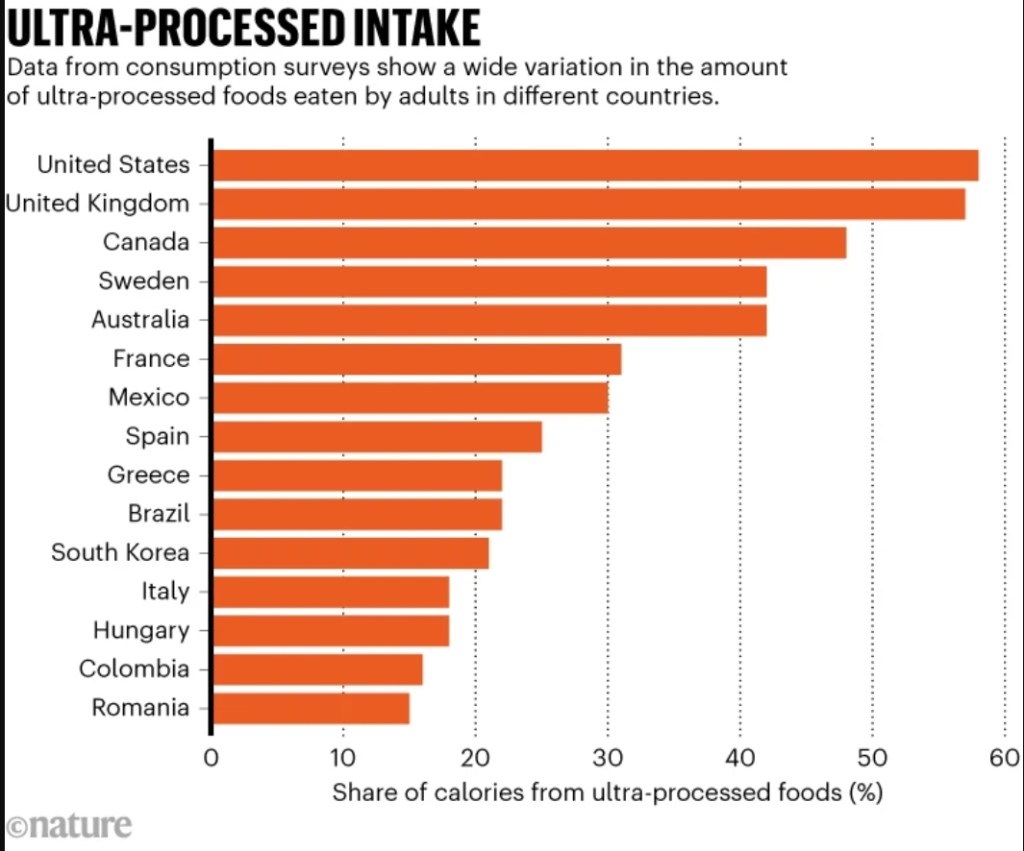
UPFs make up over 50% of the average adult diet in the UK and US, so it is important to try to understand why these foods are associated with poor health, is it just because they tend to be high in fat, salt, sugar (HFSS) or is it a more specific reason for example the industrial manufacturing process.
An important piece of research was recently published in Nature Medicine by a team from UCL, they ran the longest randomised controlled trial on UPFs to date, they compared overweight/obese participants split into two groups, both consumed diets matched for nutrients but one was made up mostly of UPFs, the other was minimally processed. They found that participants following the minimally processed diet lost twice as much weight as those on the UPF diet, suggesting that it wasn’t just nutritional content driving poor health outcomes. This increased weight gain on a diet high in UPFs was also observed in other studies, possible explanations for the weight gain were the energy dense and hyper-palatable nature of UPFs, leading to faster consumption and tendency to over-eat (Dicken, 2025).
It has also been suggested that the lack of fibre within UPFs could be another driver of ill-health, most specifically because of the negative impact this has on gut microbes which thrive on dietary fibre and help to keep blood glucose levels stable and multiple other processes such as satiety signalling, explaining further the weight gain associated with UPFs (Corbin, 2023).
There are a number of scientists that do not think there is a link between high-UPF diets and poor health, one review showed no scientific basis for a link and instead suggested confounding factors such as exercise, sleep, stress, education and socio-economic status as possible explanations (Valicente, 2023).
Another issue highlighted is the NOVA classification system which categorises processed food, some say that it is too broad, subjective and ill-defined, making it difficult to give regulatory advice.
In summary, more research is still needed into UPFs along with a better system of categorisation. In the meantime, the wisest approach is to not cut out all UPFs as some can be beneficial, instead try to eat a diet according to the Eatwell Guide and use UPFs as a way to make it more convenient and affordable. When choosing whether or not a UPF food is a good choice take into consideration the following three factors:
- Is it high in fat, salt, sugar?
- Is it soft-textured/hyper-palatable?
- Is it energy dense (high calorie content/g)?
If the answer is yes to any or all of the above then it should probably be avoided, but I would suggest this can be applied to any category of food not just those considered UPFs.
If in doubt go back to basics and keep it simple, a whole food diet, predominantly plant-rich including plenty of whole grains and legumes is a safe option!
References
Corbin et al, 2023. Nature communications (14, 3161)
Dicken et al, 2025. Nature Medicine.
Fleming, N. 2025 Are Ultra-processed Foods Really so Unhealthy. Nature (645, 22-24)
Valicente, et al. 2023. Adv. Nutr. (14, 718-738)
 MLT Nutrition