
Following on from last week’s post which discussed the Broken Plate Report and it’s analysis of sugary food products aimed at young children, I thought it would be helpful to give an example of some of the products discussed and potential alternatives.
When checking a food label, it is important to take notice of three things:
– Ingredients; these are listed in order of highest content first, generally the shorter the list the better, look out for ingredients that you wouldn’t find in an average food cupboard e.g. emulsifiers, flavourings, colourings, these are commonly contained within ultra-processed food and intake should be kept to a minimum especially for children.
– Nutritional content; in this case we are focusing on sugar content but checking fibre, calories, vitamins and minerals are also useful dietary indicators.
– Portion size; how it relates to the nutritional content especially when comparing products.
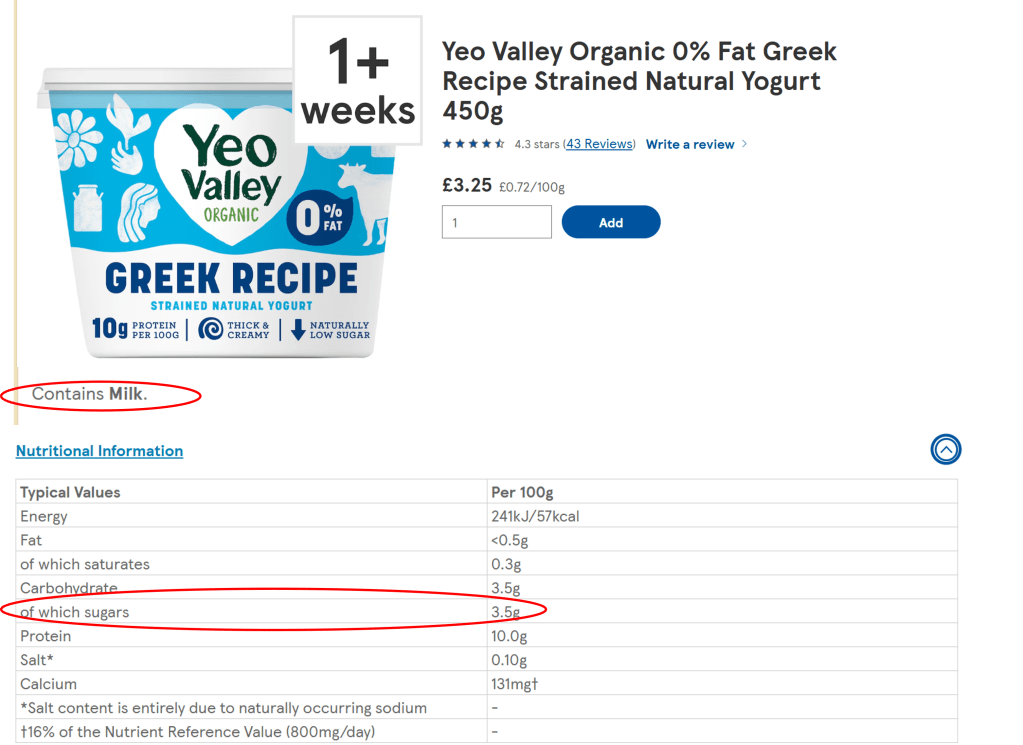
The products I have selected are yogurts, breakfast cereals and sweet snacks, these are all products aimed at children, the yogurt shown first below has a long list of ingredients which includes a number of artificial additives, it also has a sugar content of 9.3g per 100g, if you compare this to the natural yogurt which has one ingredient; milk and a sugar content of 3.5g, this is by far the healthier option.

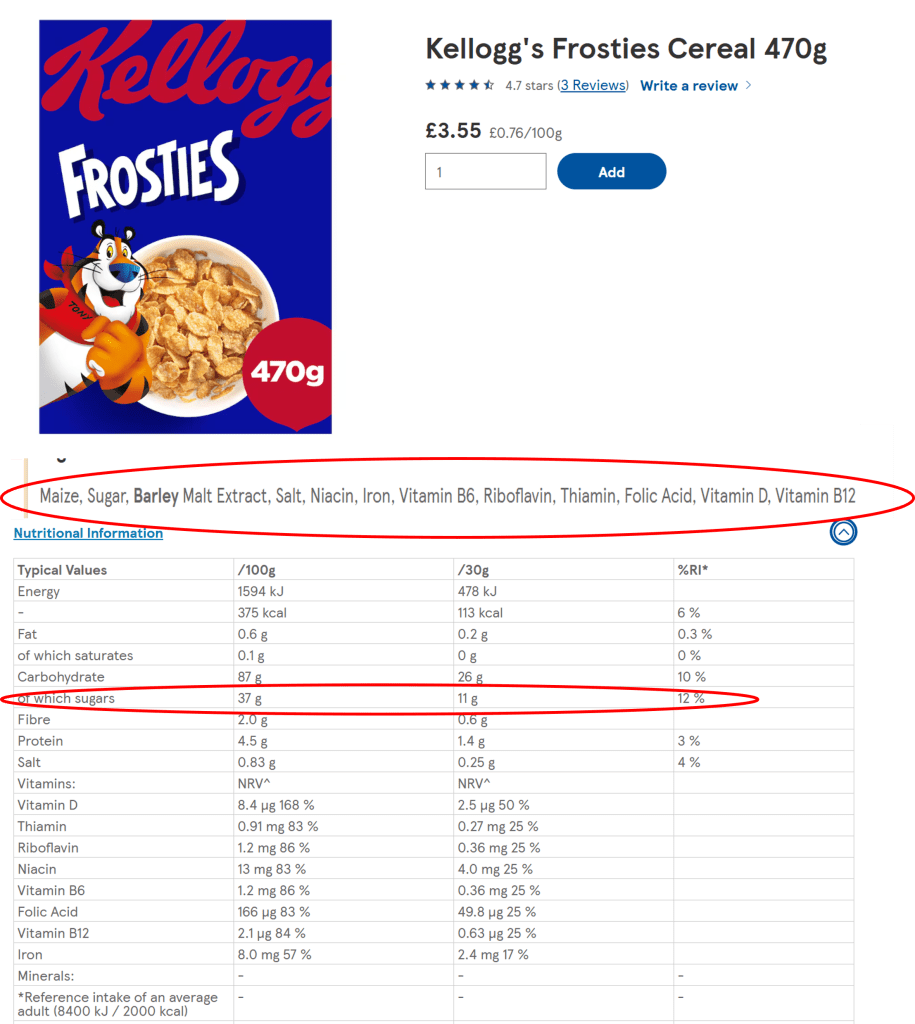
Next, breakfast cereals, these are both fortified with a variety of vitamins and minerals, an essential source for many children. The Frosties cereal has an extremely high sugar content of 37g per 100g compared to 1g per 100g of Ready Brek which also has a much higher fibre content, this is important as fibre intake is generally low for most of the UK population (Norton et al., 2024)

Lastly, sweet snacks, the Fruity Drops have an eye-wateringly long list of ingredients of which many are preservatives and artificial flavourings, it contains 65g sugar per 100g. The raisin packs also have a high sugar content, but is contained within whole food that is more valuable nutritionally, the fruits sugar enter the body packed in dietary fibre and mixed with essential vitamins, minerals and phytochemicals (Yeung et al., 2015).


These products are a drop in the ocean when it comes to grocery shopping, there are many options and unfortunately it can be very confusing and time consuming to analyse food labels on the go. It is worth checking a few items at a time, a useful tool is the NHS Food Scanner App; http://www.nhs.uk/healthier-families/food-facts/healthier-food-swaps/#fs-app, which allows you to scan a product barcode to discover the nutritional content and healthy swap suggestions.

References
Norton, V., Kaimila, Y., Lovegrove, J. A., & Lignou, S. (2024). Exploring UK older adults’ dietary fibre consumption habits and associated factors: a national diet and nutrition survey perspective. Br J Nutr, 132(4), 1-8. https://doi.org/10.1017/s0007114524001557
Yeung, C. A., Goodfellow, A., & Flanagan, L. (2015). The Truth about Sugar. Dent Update, 42(6), 507-510, 512. https://doi.org/10.12968/denu.2015.42.6.507
 MLT Nutrition