The Food Foundation (an independent charity working to address challenges within the UK food system) released its annual Broken Plate Report this week (The Food Foundation, 2025), which looked at thirteen key metrics as a way of identifying key trends impacting the accessibility and affordability of healthy food within the UK.
The results of the study were a sobering read, they found that on average healthier foods are more than twice as expensive per calorie as less healthy foods and those from the most deprived areas need to spend between 45-70% of their disposable income on food.
I’d like to highlight a part of the report that I found particularly alarming, the consumption and promotion of high sugar, salt and/or fat (HFSS) foods to young children.
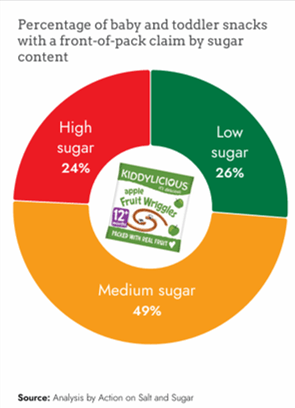
The marketing of infant foods was investigated using data provided by the independent charity Action on Salt and Sugar, they collected data from ten of the major UK supermarkets between January and April 2024 and assessed packaging using the WHO Nutrient and Promotion Profile Model(World Health Organization, 2022). The products included in the study were defined as snacks often consumed on the go, located in the baby food aisle of the supermarket and with an age guidance of 4 – 36 months. The results (see below) showed that around 75% of these products had a free sugar content (additional sugar) of medium to high, the average sugar content/100g was 17.7g, to put into context the NHS recommends that children under 4 years of age avoid consuming any free sugars(NHS, 2023). Also highlighted within the report was that the traffic light system used to assess supermarket food is based on adult recommendations, there is no criteria specific to children or baby foods which likely leads to underestimation of HFSS food content.
The sugar content in children’s products was assessed again using data sourced from Action on Salt and Sugar, they focused on breakfast cereals and yogurts as these are foods most often chosen by parents in the belief that they are healthy options. Data was collected from nine major supermarkets between January and April 2024, the inclusion criteria for the products assessed was that they contained ‘child friendly packaging’ for example the use of cartoon characters, balloon lettering and language such as ‘made for kids’. The results shown below illustrate the high sugar content of these products, only 3% of breakfast cereals and 5% of yogurts were low in sugar.
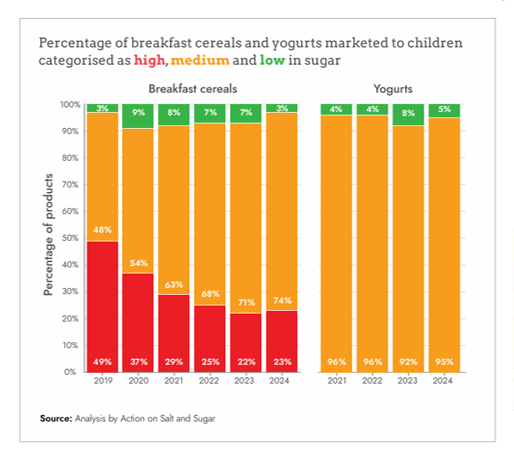
Unfortunately, this data shows a worrying pattern of decline, the availability of low sugar breakfast cereals and yogurts has reduced since 2020.
Extra vigilance is required when grocery shopping, pay close attention to the sugar content on food labels especially for those products aimed at young children as the marketing can be very misleading.
References
NHS. (2023). Sugar: the facts. www.nhs.uk/live-well/eat-well/food-types/how-does-sugar-in-our-diet-affect-our-health/
The Food Foundation. (2025). The Broken Plate Report 2025. https://foodfoundation.org.uk/publication/broken-plate-2025
World Health Organization. (2022). Nutrient and promotion profile model: supporting appropriate promotion of food products for infants and young children 6–36 months in the WHO European Region. In Nutrient and promotion profile model: supporting appropriate promotion of food products for infants and young children 6–36 months in the WHO European Region .
 MLT Nutrition