
I attended a very interesting talk this week about the benefits of a plant-based diet, it was given by the organisation ProVeg International (www.instagram.com/proveg.inter), a food awareness organisation that aims to transform the global food system into one that is equally beneficial for humans, animals and the planet.
There are many reasons why we should try to reduce our meat consumption, the most important are as follows:
Environmental Impact:
- Land used for livestock production is a major cause of deforestation and biodiversity loss globally (Willett et al., 2019).
- Animal agriculture is responsible for a third of phosphorous and nitrogen loading into freshwater (Li et al., 2022).
- Animal based food are responsible for 20% of total human-made greenhouse gas emissions (Xu et al., 2021).
Health impact:
- High meat intake is associated with increased risk of cardiovascular disease and stroke (Grosso et al., 2022)
- The International Agency for Research on Cancer classified red meat as a probable carcinogen and processed meat as carcinogenic to humans (González et al., 2020).
- Studies have shown that not eating meat can lower overall mortality by 20% (Thorogood et al., 1994).
- Even a small reduction in meat consumption can have a beneficial impact, the easiest way to start to do this is to introduce small changes of ‘protein swaps’ for example chickpeas, lentils, mushroom and aubergine are good alternatives to meat and can be used in a 50:50 proportion, any reduction in meat is a move in the right direction.
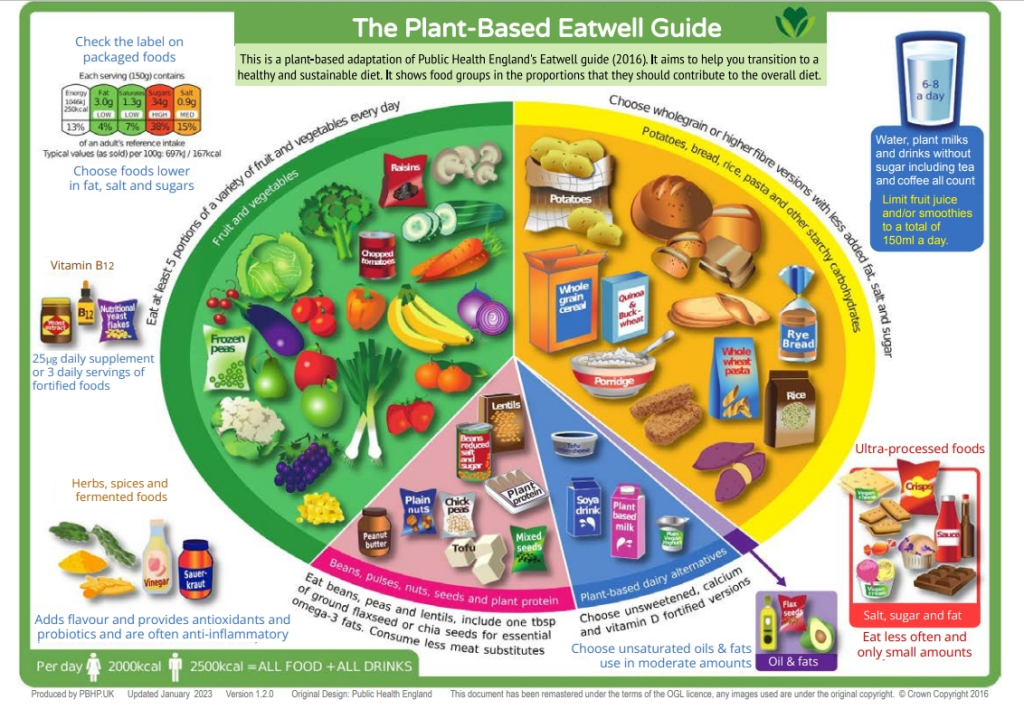
Below is an adapted version of the Eatwell Guide produced by the Plant-Based Health Professionals UK, their website along with ProVeg International provide plenty of free resources including recipes and meal planners for a plant based diet.
References
- González, N., Marquès, M., Nadal, M., & Domingo, J. L. (2020). Meat consumption: Which are the current global risks? A review of recent (2010-2020) evidences. Food Res Int, 137, 109341. https://doi.org/10.1016/j.foodres.2020.109341
- Grosso, G., La Vignera, S., Condorelli, R. A., Godos, J., Marventano, S., Tieri, M.,…Galvano, F. (2022). Total, red and processed meat consumption and human health: an umbrella review of observational studies. Int J Food Sci Nutr, 73(6), 726-737. https://doi.org/10.1080/09637486.2022.2050996
- Li, Y., Wang, M., Chen, X., Cui, S., Hofstra, N., Kroeze, C.,…Strokal, M. (2022). Multi-pollutant assessment of river pollution from livestock production worldwide. Water Res, 209, 117906. https://doi.org/10.1016/j.watres.2021.117906
- Thorogood, M., Mann, J., Appleby, P., & McPherson, K. (1994). Risk of death from cancer and ischaemic heart disease in meat and non-meat eaters. Bmj, 308(6945), 1667-1670. https://doi.org/10.1136/bmj.308.6945.1667
- Willett, W., Rockström, J., Loken, B., Springmann, M., Lang, T., Vermeulen, S.,…Murray, C. J. L. (2019). Food in the Anthropocene: the EAT-Lancet Commission on healthy diets from sustainable food systems. Lancet, 393(10170), 447-492. https://doi.org/10.1016/s0140-6736(18)31788-4
- Xu, X., Sharma, P., Shu, S., Lin, T. S., Ciais, P., Tubiello, F. N.,…Jain, A. K. (2021). Global greenhouse gas emissions from animal-based foods are twice those of plant-based foods. Nat Food, 2(9), 724-732. https://doi.org/10.1038/s43016-021-00358-x
 MLT Nutrition