This recent paper [1] outlines the development of a ‘future food’ , these are foods that are envisioned to one day be part of an alternative to the unsustainable and insecure food system that currently exists. Examples of those already in development include synthetic meats, algae, insect derived proteins, genetically modified foods and 3D printed foods, the limitations of these include poor nutritional content, cost, and taste.
This study proposes a better alternative in the form of ‘hybrid rice’ a fusion of rice grains and animal cells. The rice grains were used as a 3D scaffold upon which a coating of fish gelatin was first applied to enhance cell adhesion and stability, fish and not animal gelatin was used to reduce costs and environmental impact. Bovine derived cells in the form of myoblasts and adipose tissue derived mesenchymal stem cells were cultured within the laboratory onto the coated rice grains. The cells attached and grew around the rice grains which provided nourishment to the cells and aided their growth, this led to the creation of a bovine-cell-organized grain.
The table below outlines the nutritional content, cost, and environmental impact of the hybrid rice compared to normal ‘bare’ rice and bovine meat and shows very favourable results.
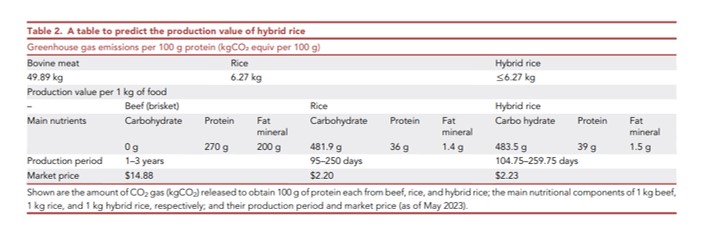
The paper suggests that more optimisation could take place to further improve the food product and proposes potential uses as space food, soldier rations and to combat hunger in food insecure countries. In the future this could be a big part of our daily diet, would you be happy eating hybrid rice as an alternative to your Sunday roast?
1. Park, S., et al., Rice grains integrated with animal cells: A shortcut to a sustainable food system. . Matter, 2024. 6(12): p. 4401-4407.
 MLT Nutrition