
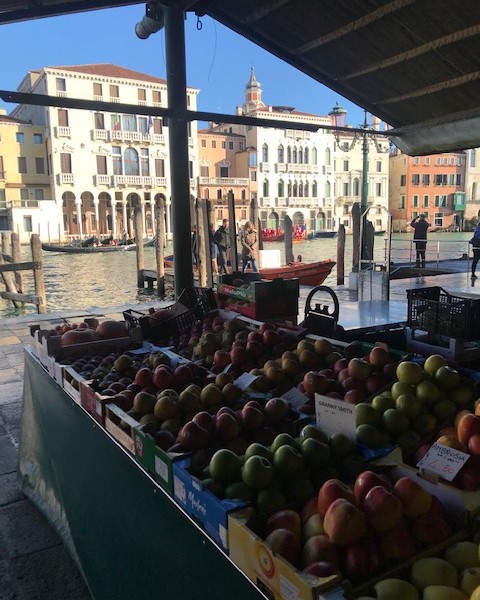
On a recent trip to Venice, I visited the famous Rialto Market and marvelled at the abundant seafood and fish on offer along with a fantastic array of fruit and vegetables, some varieties of which I didn’t recognise and others I did but their colours were so vibrant and multicoloured compared to those found in UK supermarkets. The market was buzzing with people of all ages excitedly buying ingredients for what I imagined to be some delicious culinary creation later, it was great to experience such a good example of healthy food culture. Even fast food in Venice was nutritious for example ‘Cichetti’, small pieces of bread topped with delicious vegetable, meat and fish concoctions and freshly baked takeaway pizza topped with many different vegetables and minimal cheese…. much healthier than our UK equivalents.

While in Venice I had the pleasure of experiencing fantastic traditional Italian dining at a restaurant named CoVino in the heart of the Castello district (covinovenezia.com). The meal lasted over three hours and consisted of four courses, the first was an aperitivo of mixed raw vegetables drizzled in olive oil, next were three scallops in a lemon and herb dressing, primi was spaghetti, clams, and samphire and lastly secondi was a spectacular squid, artichoke and orange mix on butternut squash puree. I didn’t need a dessert as I was fully satisfied, partly due to the slow pace of eating and also the well-portioned plates, I counted around fifteen varieties of fruit and vegetables along with perfectly proportioned carbohydrate (pasta) and protein (fish and seafood) , a great example of the Eatwell Guide plate [1]

I’m not suggesting that this calibre of food can be produced in our homes every night, but I think it would be relatively easy to incorporate a few of the components of this style of eating:
- More courses of smaller portion size (especially pasta which is typically oversized in the UK)
- Include a vegetable starter of any kind preferably raw for example salad or crudites.
- Incorporate different kinds of vegetable as an alternative to a plate dominated by carbohydrates for example butternut squash puree instead of mashed potato.
- Take time to eat and rest between each course to chat, digest and enjoy your meal, focusing on the food and company.
- No need to spend hours on fussy food, fresh seasoned vegetables drizzled in olive oil can make a delicious starter, if kids need encouragement try lightly frying in your air fryer and serve as ‘chips’ with dips (my Italian friend uses this technique very successfully with her sons)
Making these small changes can help improve:
- Pace of eating, slowing it down which can help reduce IBS symptoms such as cramps and bloating [2].
- Mindful eating, by slowing down the time taken to enjoy food and paying more attention to the effect it has on your senses this can help to reduce unhealthy behaviours such as binge and emotional eating and help weight management [3]
- Glycaemic control, many studies have shown that the order we eat food can have a significant impact on glucose[4], eating a vegetable starter can help reduce post-prandial glucose peaks [5] which long term are associated with increased risk of inflammation based diseases such as type II diabetes[6].
- Satiety and prevent overeating which can aid weight management.
References
1. PHE, The Eatwell Guide. 2016: London, Public Health England.
2. NHS’. Irritable Bowel Syndrome (IBS) – Diet, Lifestyle and Medicines. 2021; Available from: https://www.nhs.uk/conditions/irritable-bowel-syndrome-ibs/diet-lifestyle-and-medicines/.
3. Warren, J.M., N. Smith, and M. Ashwell, A structured literature review on the role of mindfulness, mindful eating and intuitive eating in changing eating behaviours: effectiveness and associated potential mechanisms. Nutr Res Rev, 2017. 30(2): p. 272-283.
4. Shukla, A.P., et al., Food Order Has a Significant Impact on Postprandial Glucose and Insulin Levels, in Diabetes Care. 2015: United States. p. e98-9.
5. Nesti, L., A. Mengozzi, and D. Tricò, Impact of Nutrient Type and Sequence on Glucose Tolerance: Physiological Insights and Therapeutic Implications. Front Endocrinol (Lausanne), 2019. 10: p. 144.
6. Donath, M.Y. and S.E. Shoelson, Type 2 diabetes as an inflammatory disease. Nat Rev Immunol, 2011. 11(2): p. 98-107.
 MLT Nutrition