Hope January is going well and just a reminder of the small challenge I set last week:
- Drink the recommended eight glasses (two litres) of water a day.
- Introduce two new fruit or vegetables a week.
- Walk/jog up and down your stairs at home ten times a day.
If like me you find it difficult to achieve your water target in the colder months you could try a decaffeinated hot drink such as herbal tea in addition to your glasses of water.
I found the stair climbing difficult at the beginning of the week but can already feel an improvement this morning and I’ve found that it’s really contributing to my daily step count.
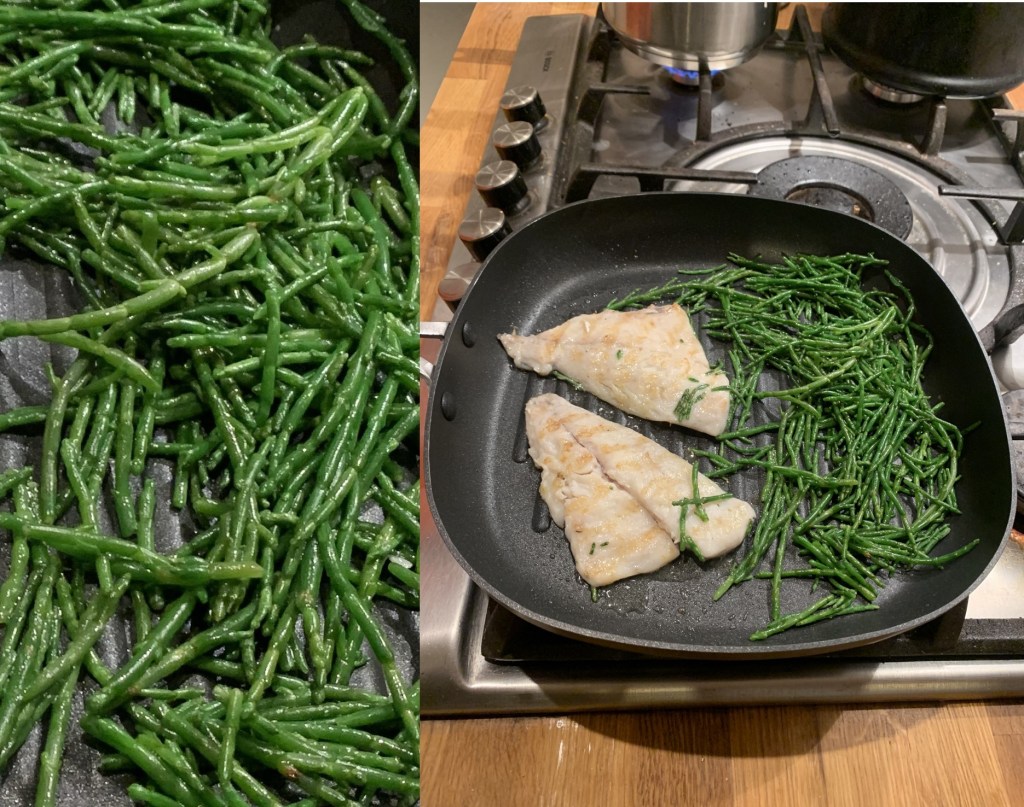
I chose to add samphire and pears to my fruit and vegetable intake this week, I hadn’t eaten samphire in a long time, and decided to swap my usual apples for in-season pears.
Samphire as it’s commonly known in the UK is an edible succulent commonly found growing on seashores and marshes, it is part of the Amaranthaceae family and has several pseudonyms such as salicornia, sea asparagus, glasswort, and sea beans. It makes a very tasty addition to salads, stir-fries, pasta or as an accompaniment to fish and is very easy and quick to prepare, it can be eaten raw, lightly pan fried or steamed. Due to it’s high sodium chloride content it has a very pleasant salty taste but should be eaten in moderation by those with high blood pressure. Samphire is very nutrient rich containing high levels of Vitamin C as well as calcium, magnesium, manganese, iodine, iron, and selenium, it is rich in polyphenols as well as antioxidants unique to this and other coastal plants [1]. As a result of it’s nutrient rich content samphire has been studied extensively and shown to have efficacy against oxidative stress, inflammation, diabetes, asthma, hepatitis, and cancer [2]. A fantastic healthy addition to your five-a-day, give it a try next time you see it at the supermarket or on a coastal walk!
1. Patel, S., Salicornia: evaluating the halophytic extremophile as a food and a pharmaceutical candidate. 3 Biotech, 2016. 6(104).
2. Essaidi, I., et al., Phytochemical investigation of Tunisian Salicornia herbacea L., antioxidant, antimicrobial and cytochrome P450 (CYPs) inhibitory activities of its methanol extract. . Food Control, 2013. 32: p. 125-133.
 MLT Nutrition